

UK Vape Tax 2026
UK vape tax 2026: The Ultimate Guide to the New E-Liquid Changes
UK vape tax 2026 is the biggest topic on every vaper's lips right now, and it is going to completely change how we buy our favourite juices. Alright, let’s chat. Grab a brew, pull up a chair, and let’s talk about the massive piece of news that’s been buzzing through the community. If you’ve been keeping half an eye on the news lately, you’ll know that the government has dropped a bit of a bombshell regarding our bottles. We are looking down the barrel of a brand-new UK vape tax 2026 framework, and it is going to shake up the tills at Vaping Heaven and every other shop in the country.
Now, don’t panic just yet. It’s not the end of the world, but the days of picking up a massive bottle of shortfill for absolute pocket change are drawing to a close. Officially dubbed the Vaping Products Duty (VPD), this new excise tax is a complete rethink of how the Treasury treats e-liquid. For years, vaping has been a fantastic way to escape traditional cigarettes without emptying your wallet. But as the industry grows up, the government wants its cut, meaning every single millilitre of juice will soon carry its own dedicated duty.
In this deep dive, I’m going to lay out the cold, hard facts without any confusing tech jargon or dry political spin. We’ll look at exactly how much more you’ll be paying for your go-to e-liquids, freebase nicotine, nic salts, prefilled pods, and shortfills. More importantly, I’ll share a few pro tips on how you can beat the price hike before the legislation fully locks into place. Let’s break it all down together like a couple of mates over a pint.
Table of Contents
- The Structural Blueprint: What is the Vaping Products Duty?
- The Flat-Rate Shock: Why Nicotine Strength Doesn't Matter
- The Price Breakdown: Exactly How Much More Will You Pay?
- The Shortfill Paradox: Why the Big Bottles Get Hit Hardest
- What's NOT Taxed: The Safe Zones for Your Wallet
- Key Dates: The Vape Tax Timeline You Need to Know
- Nick's Insight: Top Tips to Beat the Tax Hike
- Will Vaping Still Be Cheaper Than Smoking?
- Conclusion & Next Steps
- FAQ: The Quick Hits
The Structural Blueprint: What is the Vaping Products Duty?
For years, the UK government has treated vaping as a vital tool for smoking cessation, keeping it relatively unburdened by specific "sin taxes" aside from standard 20% VAT. However, under the finalized legislative terms of the Tobacco and Vapes Act, a dedicated excise duty will land on all e-liquid manufactured in or imported into the UK starting later this year.
Think of it like a toll bridge. Up until now, your e-liquid has enjoyed a smooth, open road. From the launch date, every single millilitre of liquid has to cross the HMRC toll plaza. The published rate is a flat £2.20 per 10ml of e-liquid. But here’s the kicker that catches most people off guard: excise duty gets hit with standard 20% VAT at the final point of sale. When you do the math, that £2.20 excise charge actually morphs into an effective £2.64 price increase per 10ml for the consumer at the shop counter.
The Math at the Counter:
[Excise Duty: £2.20] + [20% VAT: £0.44] = Total Retail Increase: £2.64 per 10ml bottle.
It’s a flat-rate liquid tax, meaning it is calculated purely by volume, not by the complexity of the device, the brand name on the label, or whether it’s a budget line or a boutique selection. Because manufacturers and wholesalers work on razor-thin margins, they cannot simply absorb a massive cost hike. These costs will inevitably ripple down the supply chain directly to the retail tills.
The Flat-Rate Shock: Why Nicotine Strength Doesn't Matter
When the UK vape tax 2026 framework was first floated in initial government consultations, the plan was to introduce a tiered system. Higher nicotine strengths (like 20mg nic salts) were supposed to be taxed heavily, while zero-nicotine bottles were going to be let off lightly. The idea was to penalise nicotine consumption while rewarding those stepping down their strengths.
However, the government completely scrapped that idea, opting instead for a streamlined, flat-rate approach. Under the finalized rules, all e-liquids are taxed exactly the same, regardless of nicotine content. This has sent shockwaves through the community because it defies standard public health logic. Whether you are hitting a high-strength pod to keep off the cigarettes or blowing massive, nicotine-free clouds on a sub-ohm mod, the Treasury views your liquid exactly the same.
- 0mg Shortfills: Taxed at £2.20 per 10ml (+ VAT).
- 10mg Freebase Juice: Taxed at £2.20 per 10ml (+ VAT).
- 20mg quality Nic Salts: Taxed at £2.20 per 10ml (+ VAT).
It’s a bit like buying a ticket for a train—the guard doesn't care if you're carrying a heavy suitcase or traveling completely light; a seat is a seat, and you pay the full fare regardless. This simplifies collection for HMRC, but it means cloud-chasers and zero-nicotine users are in for a serious surprise.
The Price Breakdown: Exactly How Much More Will You Pay?
Let's look at how this changes the actual cost out of your wallet. Below is a realistic matrix of how the UK vape tax 2026 will impact various product types across the market once old stock clears out. Prices are estimated based on current market averages combined with the new mandatory duty addition.
UK Vape Tax 2026 Retail Impact Estimation Matrix
| Product Type | Liquid Volume | Current Avg Price | New Duty + VAT Impact | Estimated New Shelf Price | Percentage Jump |
|---|---|---|---|---|---|
| Budget 10ml Bottle | 10ml | £3.00 | +£2.64 | £5.64 | ~88% |
| 10ml Nic Salt | 10ml | £3.99 | +£2.64 | £6.63 | ~66% |
| Prefilled Pods (2x2ml Pack) | 4ml | £6.00 | +£1.06 | £7.06 | ~17% |
| 50ml Shortfill (No Nic) | 50ml | £11.99 | +£13.20 | £25.19 | ~110% |
| 100ml Shortfill (No Nic) | 100ml | £14.99 | +£26.40 | £41.39 | ~176% |
| 10ml Nic Shot | 10ml | £1.49 | +£2.64 | £4.13 | ~177% |
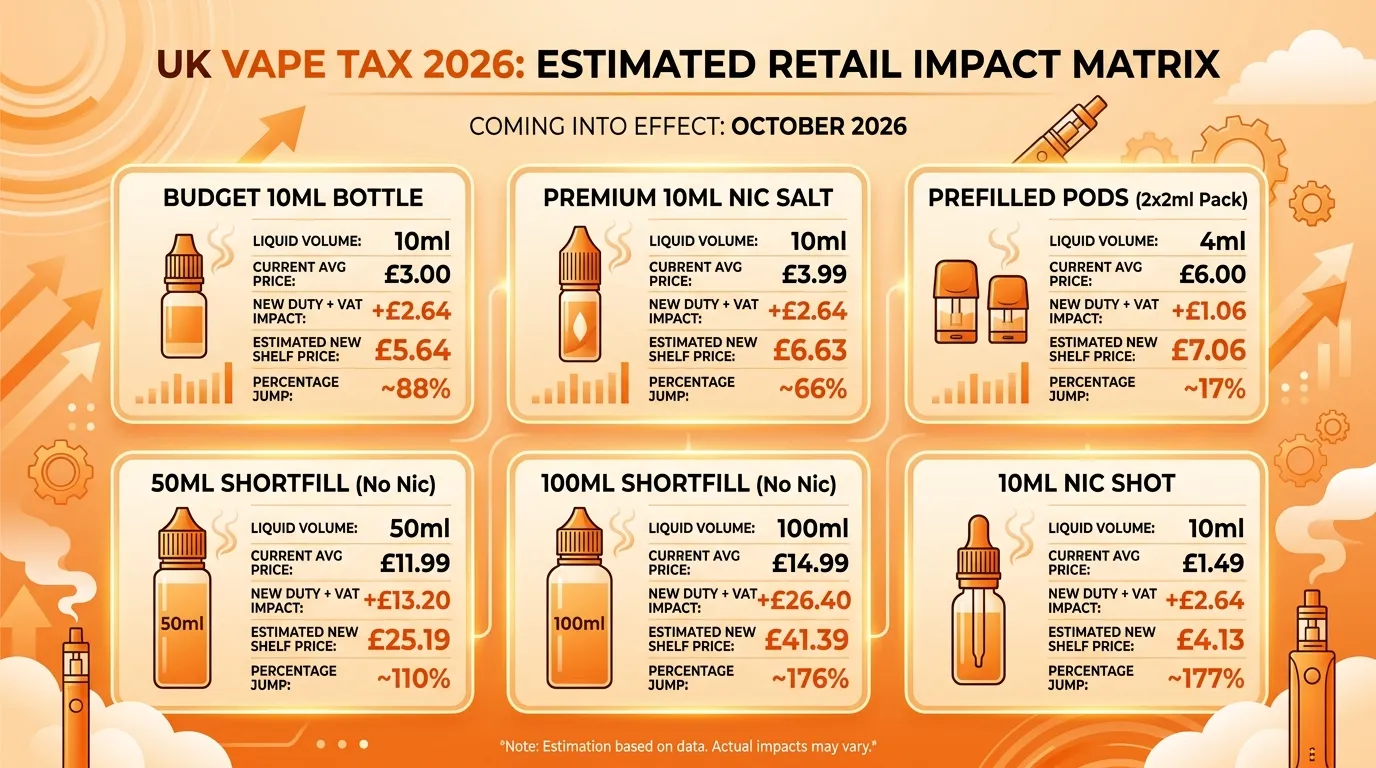
Look at those numbers closely. A budget 10ml bottle that currently costs you three quid will nearly double in price. A standard quality nic salt moves from a reasonable £3.99 up to over six and a half quid. It is a stark visual shift, and it’s why understanding the breakdown is vital for your weekly budget.
The Shortfill Paradox: Why the Big Bottles Get Hit Hardest
If you love your high-wattage sub-ohm setups, I’m afraid I’ve got some tough news. The new layout reveals a massive quirk known across the industry as the Shortfill Paradox. This is where the UK vape tax 2026 turns the entire value market completely on its head.
Shortfills were originally invented as a clever way to bypass the TPD’s 10ml bottle limit on nicotine-containing e-liquids. By selling a 100ml bottle filled with 0mg juice, manufacturers left room at the top for you to pop in a couple of 10ml nic shots. Because they were nicotine-free, they skipped the tightest retail restrictions and offered unmatched value per millilitre. It was the ultimate budget hack for cloud-chasers.
But because the new tax targets volume instead of nicotine risk, the economics of shortfills have completely flipped. Look at how a 100ml bottle is treated:
- A 100ml shortfill attracts 10 units of the 10ml tax, adding a crushing £22.00 of raw duty.
- Add the 20% VAT on the duty (£4.40), and the tax alone adds £26.40 to the cost of that single bottle.
- Then, you still have to buy your two 10ml nic shots to bring it up to strength. Each of those shots carries an extra £2.64 in tax + VAT.
When the dust settles, a complete 100ml shortfill kit that used to set you back roughly £15 to £18 could easily skyrocket over £45 at the counter. In a bizarre twist of legislative irony, the most eco-friendly, sustainable format with the least youth-appeal is getting hit with a massive price hike, while prefilled pod systems—often critiqued for plastic waste—see a much smaller percentage bump because their volume is capped at a tiny 2ml per pod.
What's NOT Taxed: The Safe Zones for Your Wallet
While the e-liquid landscape is getting a major financial shake-up, it’s worth noting exactly what is escaping the taxman's net. The Vaping Products Duty applies strictly to the liquid itself, meaning your hardware purchases won't be hit by this specific extra levy.
The following items are completely exempt from the new excise tax:
- Refillable Vape Kits & Mods: Your actual electronic hardware, batteries, and internal circuit boards remain untaxed. Sleek starter kits and heavy sub-ohm mods won't see an excise jump.
- Replacement Coils & Tanks: Wires, mesh elements, organic cotton wicks, and empty glass tanks are excluded from the duty.
- Empty Refillable Pods: The plastic cartridges you fill yourself will not see any duty added, making refillable systems far more economical than prefilled options.
- DIY Flavour Concentrates: Pure food-grade flavorings used for DIY mixing (which are not meant to be vaped straight out of the bottle) remain standard.
Key Dates: The Vape Tax Timeline You Need to Know
This isn’t all happening overnight, which gives us a precious window to plan ahead. HMRC has laid out a clear legislative runway so manufacturers, distributors, and retail businesses can get their houses in order. This timeline shows exactly how the rollout works:
- 1 April 2026: The HMRC Gates Open
HMRC opens its official registration portals for all domestic e-liquid manufacturers and commercial importers. Businesses must log their facilities and prepare for the strict oversight of production volumes. This runs parallel to international adjustments, like China's vape export tax rebate cancellation, which already began shifting global manufacturing margins earlier in the year. - 1 October 2026: D-Day (The Duty Drops)
The Vaping Products Duty officially becomes active. Any e-liquid manufactured or imported from this date must have its duty fully accounted for, and the outer retail packaging must display a physical duty stamp. Think of it like the little paper labels you see sealed across the caps of whiskey or vodka bottles in the supermarket—it's your proof that the taxman has taken his cut. - 1 October 2026 to 31 March 2027: The Grace Period
This is the critical bit for everyday consumers. The government has allowed a six-month sell-through window. If a vape shop or warehouse has stock on its shelves that was manufactured before the 1 October deadline, they can legally sell it without a duty stamp at current, pre-tax prices until the end of March 2027. - 1 April 2027: Absolute Cut-Off
The grace period slams shut. From this day forward, it is completely illegal for any UK retailer to sell a bottle, pod, or prefilled device unless it features a verified HMRC duty stamp, regardless of when it was made.
John's Insight: Top Tips to Beat the Tax Hike
Alright mate, let’s talk strategy. Nobody likes paying extra to the taxman, but if you play your cards right, you can completely sidestep the worst of this price spike for a long time. Here is my blueprint for protecting your wallet as the UK vape tax 2026 rolls out.
First, Stock Up Early & Store Smart. Legal e-liquids have a remarkably stable shelf life of one to two years if you keep them right. If you gradually build up a reserve of your favourite shortfills or nic salts before October, you will be vaping at current prices well into next year. Keep your bottles in a cool, dark cupboard away from direct sunlight to preserve the flavour profiles and nicotine integrity. Don't panic buy a bunker full of pods all at once, but grabbing an extra pack or a couple of extra bottles on your regular shop visits is a very smart move.
Second, Rethink Your Hardware Efficiency. If you are blowing through 20ml of shortfill juice a day on a massive triple-battery sub-ohm kit, that habit is going to cost you an extra fifty quid a week in tax alone. Consider switching over to a compact, low-powered refillable pod kit. Modern mouth-to-lung pod setups offer fantastic flavour delivery but use a fraction of the liquid compared to heavy cloud setups. Lower-wattage kits stretch your bottles much further, saving you a massive amount of money over the year.
Finally, Bump Up the Strength, Drop the Volume. If you usually vape 3mg freebase juice in huge quantities, consider moving up to a 10mg or 20mg nic salt setup. Because salts hit your bloodstream faster and satisfy cravings efficiently, you will find yourself taking far fewer puffs throughout the day. Less liquid vaporized means less tax paid—simple math!
Will Vaping Still Be Cheaper Than Smoking?
With prices scaling up across the board, a lot of people are asking the million-dollar question: Is it still worth vaping over traditional smoking? The short answer is: Absolutely, by a country mile. Vaping remains a much cleaner alternative to traditional smoking, drastically reducing exposure to harmful chemicals found in cigarettes.
To prevent the new tax from driving ex-smokers back onto combustible tobacco, the government is simultaneously raising tobacco duty. This ensures a massive, protective financial gulf remains between the two choices. Consider a pack-a-day smoker. In the UK, a pack of 20 cigarettes is set to soar past £17.39 to £21.00. For someone smoking a pack a day, that translates to a staggering yearly expenditure of roughly £6,300 to £7,600.
In contrast, let's look at a moderate vaper getting through roughly 60ml of quality nic salt e-liquid every month using a refillable pod system:
- Pre-Tax Annual E-Liquid Spend: ~£240
- Post-Tax Annual E-Liquid Spend: ~£400
- Plus Coils and Replacement Pods: ~£100
- Total Post-Tax Cost: ~£500 per year
Even after the tax takes full effect, a moderate vaper will spend less than a twelfth of what a regular smoker pays over twelve months. The financial savings don't disappear; the gap simply narrows slightly. Vaping remains an incredibly accessible, far less harmful alternative for adult smokers looking to ditch the tar and carbon monoxide.
Conclusion & Next Steps
There’s no hiding from it—the incoming Vaping Products Duty is the biggest regulatory curveball thrown at the UK scene since the original TPD rules landed a decade ago. The UK vape tax 2026 is going to make our favourite bottles more expensive to move around the globe and shift off the shelves, but it doesn't mean you have to break the bank.
The vaping community is incredibly resilient, and the industry is already adapting. Manufacturers are exploring highly concentrated longfills and smart new hardware variations to help mitigate the cost jump for the consumer. The single best move you can make right now is to stay informed, avoid panic buying, and plan ahead strategically. Stock up on your favorite shortfills while current prices hold, look out for the official HMRC duty stamp down the line, and make sure you keep your kit running as efficiently as possible.
Ready to get ahead of the price hike? Explore our massive range of quality e-liquids and shortfills at Vaping Heaven today, and lock in your favorite flavours at pre-tax prices while stocks last!
FAQ: The Quick Hits
Does the UK vape tax apply to 0mg e-liquid?
Yes, absolutely. The finalized Vaping Products Duty is a flat-rate tax calculated entirely by the volume of the liquid, meaning zero-nicotine shortfills face the exact same £2.20 per 10ml charge as regular nicotine e-liquids. The government opted for a simple volume-based calculation rather than a tiered nicotine system.
Can I buy untaxed vape juice online after October 2026?
No, there are no legal loopholes. Because the excise tax is applied at the point of manufacture or initial UK customs import, every single legal brick-and-mortar shop and online retailer will face the exact same cost base. Any website offering unstamped juice after the grace period ends is operating illegally outside of UK law.
Are disposable vapes affected by this tax?
Disposable vapes are facing separate, total environmental restrictions under the Tobacco and Vapes Act due to litter and youth appeal. For any legal, prefilled big-puff options or modular pod kits containing liquid left on the market, the flat volume rate applies directly to whatever liquid volume is contained within the pod device.
How can I verify that my e-liquid is legal after the tax starts?
From October 2026, all legal e-liquids must feature a visible, physical HMRC duty stamp directly on their outer retail packaging. By April 2027, this stamp becomes completely mandatory for all retail sales, serving as your guarantee that the product is fully compliant, tested, duty-paid, and safe to use.